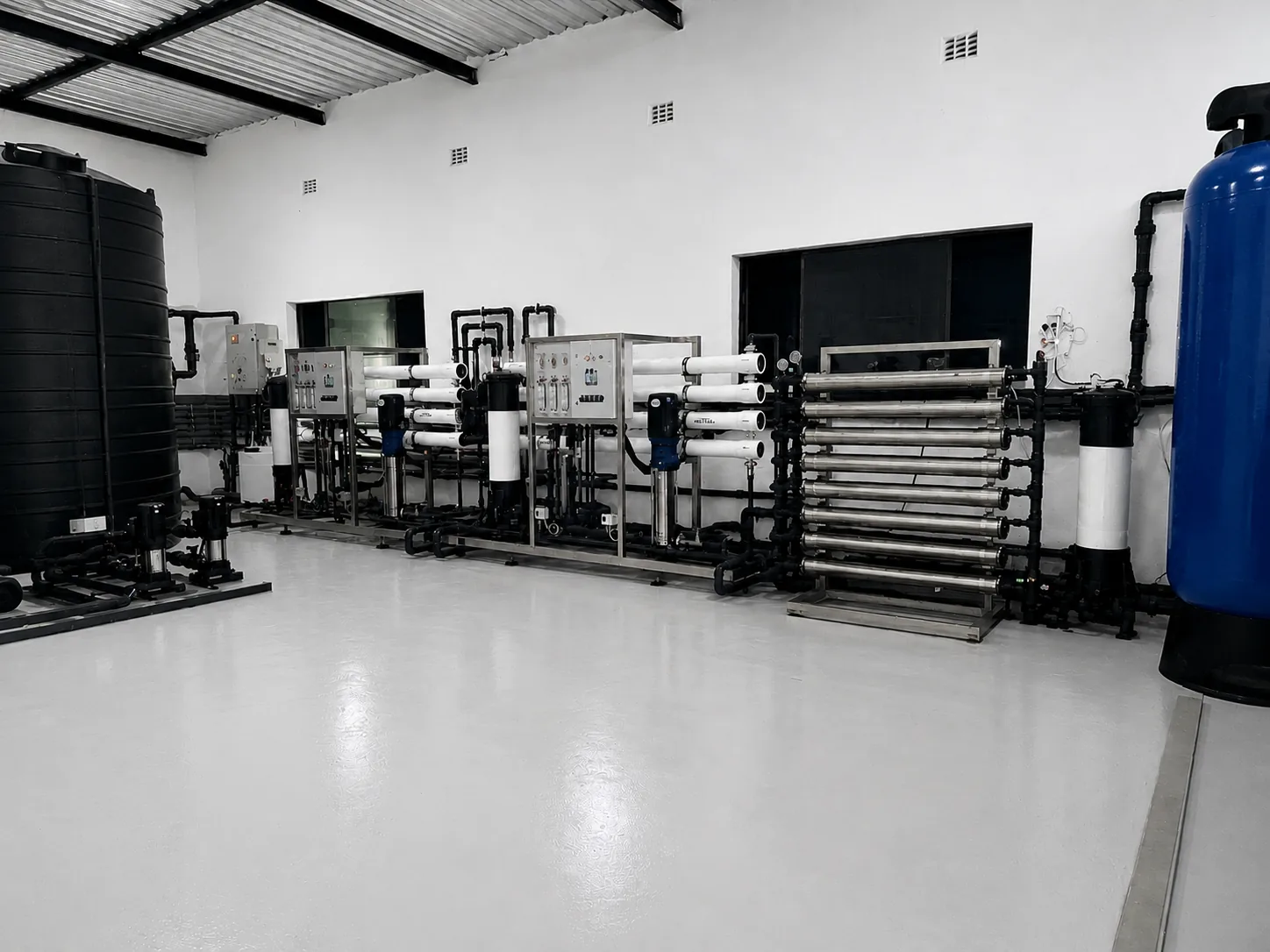
A common scene on a site survey: the previous supplier installed a reverse-osmosis train on a borehole that was already low-TDS, soft and microbiologically suspect. Reverse osmosis is solving the wrong problem. Ultrafiltration would have done the job at a fifth of the energy cost and double the recovery rate. Three years later the membranes are scaled, the operator hates the chemistry, and everyone blames the borehole again.
Each membrane technology has a job description. Get it wrong and you pay for it forever.
Ultrafiltration (UF) — 0.01 µm physical barrier
UF removes bacteria, cysts, viruses (with chemistry), turbidity and colloidal organics. It does not remove dissolved salts, hardness, fluoride, nitrate or heavy metals. It is the right answer when the source water is microbiologically risky but chemically benign — most South African upland surface water, most modern boreholes drilled into clean dolomitic or quartzitic aquifers. Recovery is typically 90–95%. Energy: ~0.1 kWh/m³ (Crittenden et al., 2012).
Reverse osmosis (RO) — 0.0001 µm separation
RO removes everything UF does, plus dissolved salts, hardness, heavy metals, fluoride, nitrate, and most organics. It is the right answer when source TDS is above ~600 mg/L, or where specific contaminants (fluoride above 1.5 mg/L, nitrate above 11 mg/L, manganese above 0.4 mg/L) require dissolved-phase rejection. Recovery is typically 50–75% — the rest is concentrate. Energy: 0.5–1.2 kWh/m³ depending on feed pressure and recovery (DuPont, 2023).
Nanofiltration (NF) — 0.001 µm, the middle child
NF rejects divalent salts (calcium, magnesium, sulphate) at 70–95% but passes monovalent salts (sodium, chloride) at 40–60%. It is the right answer for softening, partial desalination, and disinfection by-product precursor removal — usually between UF on the front end and a polishing stage on the back. Energy and recovery sit between UF and RO.
The diagnostic is always the same: a full SANS 241 panel on the source water, a clear definition of the outlet specification, and a treatment train sized against the gap between them. Everything else is a brochure.