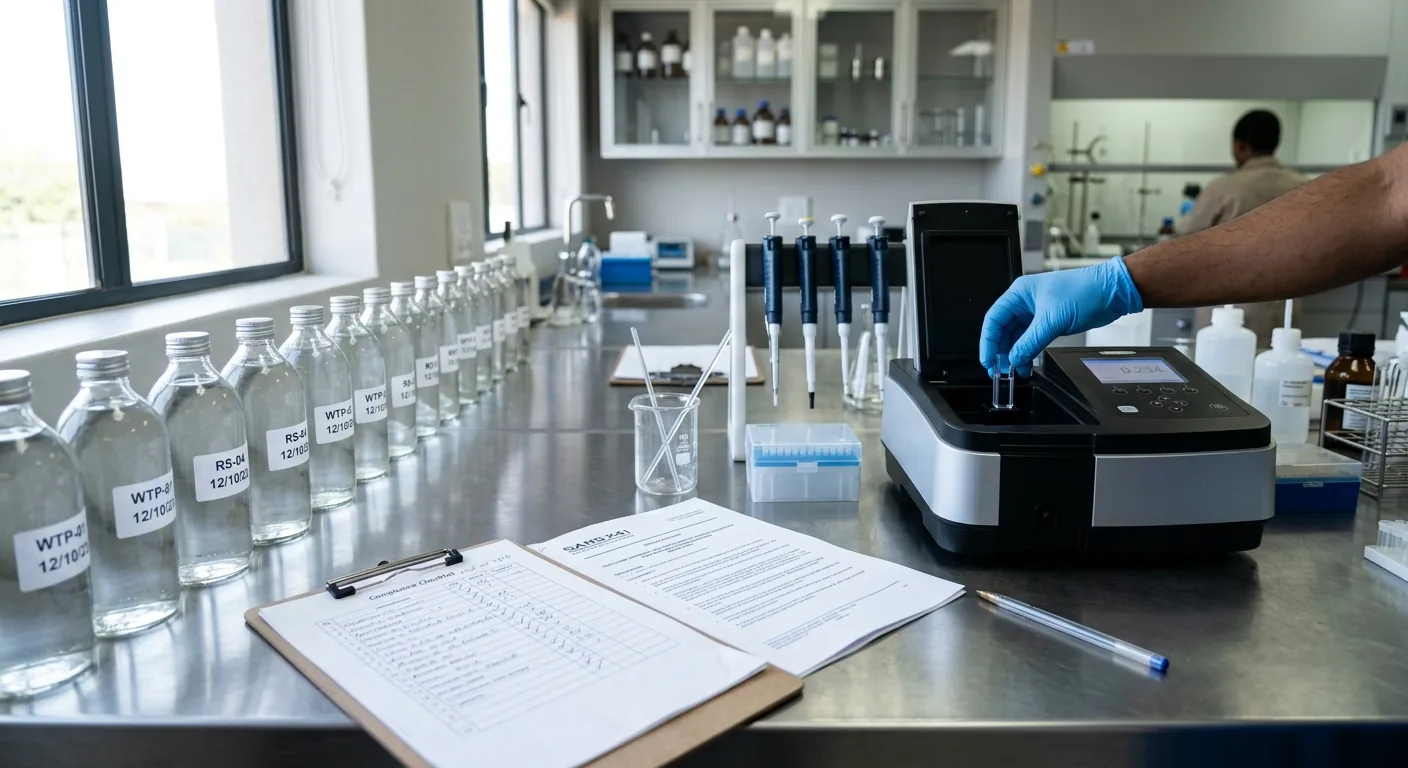
"Our water is SANS 241 compliant." We hear it on the first site walk, often delivered with the confidence of someone who has seen one annual lab report in three years. The report tested E. coli and total coliforms. SANS 241:2015 actually defines acute-health, chronic-health, aesthetic and operational determinants across twelve classes (SABS, 2015). Annual bacteriology covers one corner of one class.
The second misread is the sample point. The standard is written to be defended at the point of consumption — the kitchen tap, the suite basin, the spa drinking fountain — not at the plant outlet. Free chlorine residual that leaves the plant at 0.6 mg/L can sit at 0.18 mg/L at the far villa after a 240-m gravity-fed reticulation in summer (SABS, 2015 §5.6.2). The plant is compliant. The villa is not. The audit will name the villa.
The third misread is sampling cadence. SANS 241 is a specification, not a sampling protocol — but the Water Services Act of 1997 and the Compulsory National Standards (Regulation R982 of 2001) require a Water Services Intermediary to demonstrate routine monitoring. For a luxury lodge that means, at minimum:
- Monthly bacteriology (E. coli, total coliforms, HPC) at four representative outlets.
- Quarterly operational chemistry (free chlorine, conductivity, pH, turbidity).
- Annual full SANS 241 panel including heavy metals, fluoride, nitrate, disinfection by-products.
- SANAS-accredited laboratory throughout. Field strips do not count.
What the auditor actually asks for
The auditor wants three documents in three minutes: the most recent monthly bacteriology report, the most recent annual full panel, and the corrective-action log for any out-of-spec determinant in the last 24 months. Lodges that pass the visit have those documents in a single PDF binder. Lodges that fail have them across three inboxes, two WhatsApp threads and a 2022 site notebook.
The standard is not the hurdle. The file is.