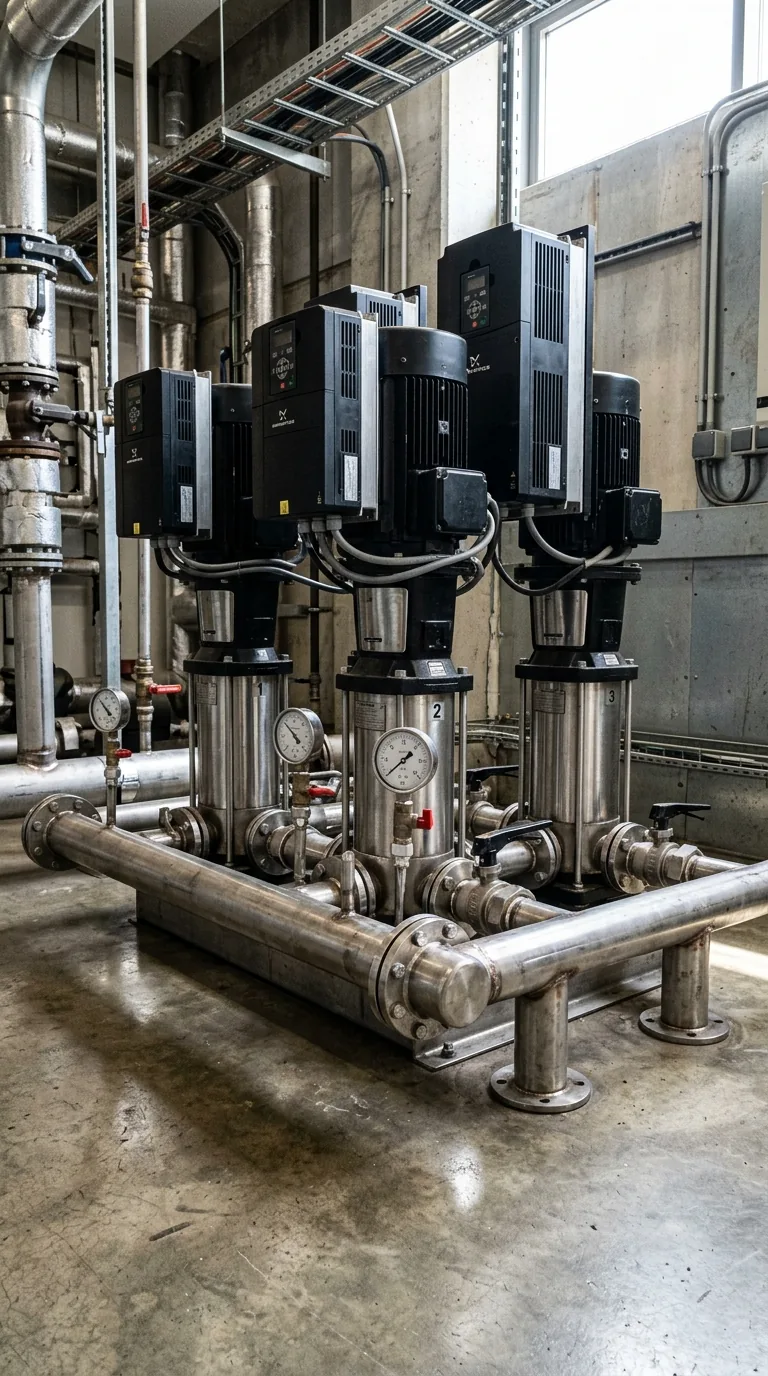
The classical pressure-vessel booster set works like this: a fixed-speed pump runs flat out until the vessel pressure hits the high setpoint, the pump stops, the vessel discharges into the reticulation, pressure falls to the low setpoint, the pump starts again. The reticulation sees a sawtooth pressure profile, the pump sees a cycling profile, and the pipework sees water hammer at every cycle.
It works. It has worked for forty years. It also wakes the guest in suite 12 at 02:00 when the kitchen fills the ice machine and the cycle restarts under their floor.
Constant-pressure VSD — what changes
A variable-speed drive modulates pump speed to hold a constant downstream pressure (typically 3.5–5.5 bar) regardless of demand. The pump never cycles fully off as long as there is any draw; when draw stops, the pump idles at a soft floor. Result: a flat pressure profile, no hammer, no cycling stress on pipework, and the pump sees half to a third of the start-stop events it would otherwise endure.
The energy picture is the more compelling argument. Pump-affinity laws make pump power scale with the cube of speed. A pump running at 70% speed draws ~34% of its full-speed power. On a real lodge demand curve — where most hours sit well below peak — the savings are typically 25–40% measured against a fixed-speed equivalent over twelve months (Grundfos, 2021).
The acoustic argument
Suite-near plant rooms live under a noise budget. The fixed-speed pump operates at one acoustic state — full speed — at every start. Constant-pressure VSD spends most of its operating life below 60% speed, where the acoustic signature drops by 8–14 dBA (Bies & Hansen, 2017). On a luxury site this is not a luxury upgrade. It is the difference between a complaint and a review.
Modern VSD pressure sets are not a premium product anymore. They are the default, and the pressure-vessel system is the exception kept for the very lightest duty.