Rainwater Capture Systems
Every roof is a water source — if you treat it like one.
The technology explained.
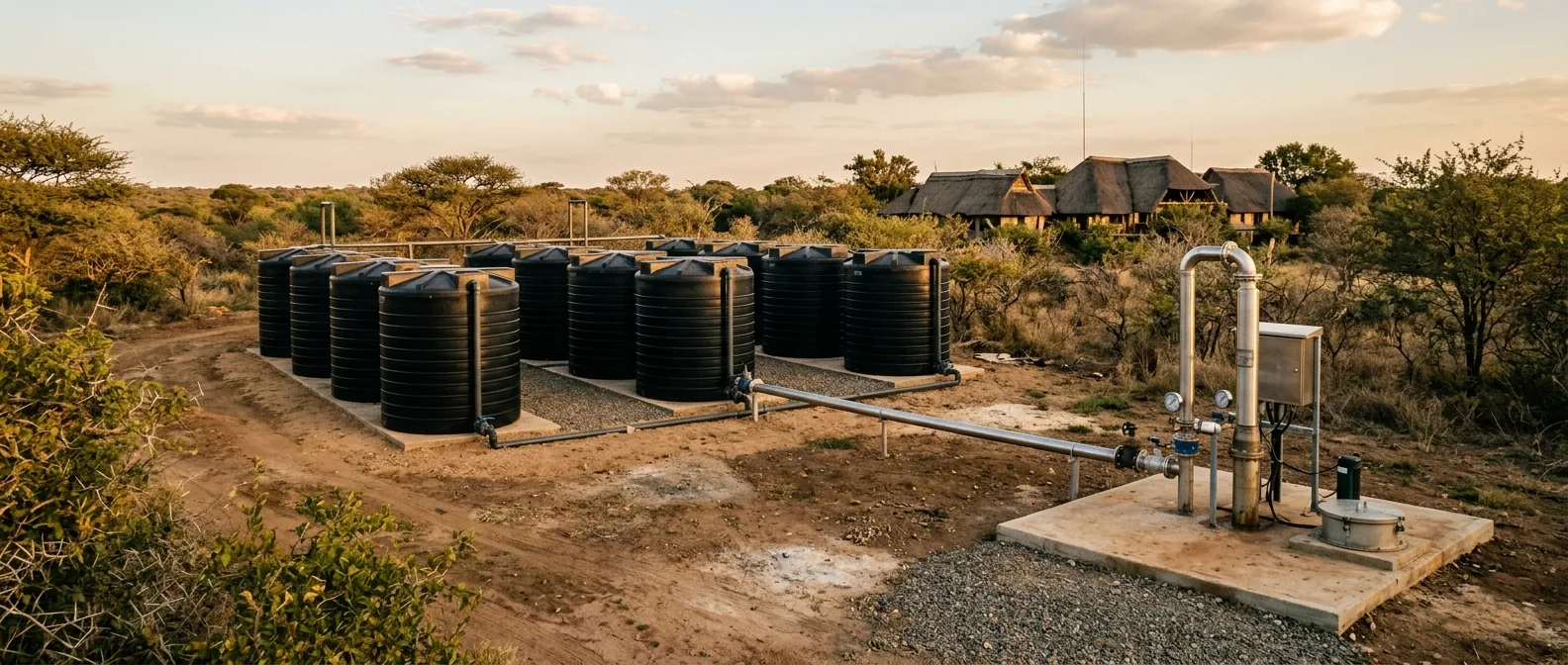
Rainwater capture systems collect runoff from roofs and clean catchment surfaces, divert first-flush load, screen leaves and debris, and store water in sized tanks for later use. Modern installs include first-flush diverters, mesh leaf screens, calmed inlets and bypass overflows engineered against the catchment-area design rainfall.
- Captures roof and clean-catchment runoff for storage and re-use.
- Diverts the polluted first-flush volume away from the storage tank.
- Reduces dependence on borehole or municipal supply during the wet season.
- Provides emergency reserve buffer during dry-season abstraction restrictions.
- High-rainfall coastal and escarpment sites with consistent wet-season volume.
- Lodges and estates with substantial clean-roof catchment area.
- Sites pursuing certified water-management benchmarks (LEED, EDGE, Green Star).
- Drinking-water augmentation for high-occupancy peak-season periods.
- ×Won't carry a high-demand site through a long dry season on its own.
- ×Cleanliness depends on roof material — asbestos, certain coatings and bird-heavy roofs need additional treatment.
- ×Storage volume vs catchment area must be calculated honestly — undersized either side wastes capital.
- ×Rainwater is not potable as captured — treatment is always required for drinking duty.
Where Rainwater Capture Systems is used.
- Residential drought resilience
- Lodge supplementary supply
- Estate landscape irrigation
- Agriculture supplementary water
How HidroVerse deploys Rainwater Capture Systems.
We integrate rainwater capture into the site water balance as a real source — sized against the design rainfall and the demand, with first-flush diverters and a calmed inlet that protects the storage from disturbance.
A typical Rainwater Capture Systems treatment chain.
Rainwater capture is a primary source, sized against the catchment, the rainfall and the demand. Treatment downstream is non-optional.
Pre-treatment
Mesh leaf screens on the gutters; first-flush diverters sized against the historical worst rainfall event; calmed inlet to the storage tank.
Core stage
Sectional or moulded storage tank sized against catchment area and design rainfall; bermed, screened or built into the architecture to disappear.
Post-treatment
Filtration, disinfection and (for potable duty) the full purification train; smart blending logic where rainwater shares storage with other sources.
Waste handling
Tank overflow routed to soakaway or rainwater swale; first-flush volume routed to landscape rather than tank.
Buyer's guide.
The questions every commercial buyer should put on the table before signing for a water system. Can't see yours? Send us a brief — a HidroVerse specialist replies within one business day.
Yes — we keep a current reference list organised by application and scale. After a short qualifying call we release names, contacts and (with the host's permission) site-visit options. The conversation between two operations managers is the most honest reference we can offer; we do not gate-keep it.
We start with a SANAS-accredited feed-water panel, profile your demand against verified occupancy or production data (not brochure numbers), and specify against the worst-credible feed and peak demand — with disclosed margins. If a simpler technology will hit the brief, we'll specify the simpler technology and tell you why. We do not earn more by over-spending you; we earn more by you renewing service contracts year after year.
PFD, P&IDs, sizing calculations against verified influent data, equipment schedules with serial numbers, control philosophy, pre-treatment justification, waste-handling and regulatory compliance trail. Audit-ready by an external ECSA-registered engineer is the standard we design to — not a brochure pack with marketing fluff.
Pre-treatment is technology-specific (sediment, hardness, chlorine, biological load) and non-optional. Skipping it is the single largest cause of premature failure on every membrane, media bed and disinfection stage. Watch for suppliers quoting only the core stage — they are selling you a 12-month problem.
Every consumable and major component has a quantified replacement trigger (differential pressure, flow drop, UV intensity drop, salt-passage drift). Replacement schedules and trigger limits are written into the HidroVerse Care contract — visible, auditable and triggered on monitoring data, not guesswork.
Critical components are specified with duty/standby and automatic fail-over so a single failure does not stop supply. Our SLA on critical lines is 4 hours on site; the median lived response over the last 14 months is 2 hours 40 minutes. Telemetry triggers tickets before the operator notices — most failures are flagged, not phoned in.
Continuous telemetry on flow, pressure, conductivity, turbidity and on-skid water quality. Monthly SANAS-accredited compliance sampling is included on HidroVerse Care — not invoiced piecemeal. The audit pack builds itself monthly so when DWS or your insurer arrives, the file is ready in 30 minutes.
Potable applications: SANS 241:2015 (mandatory under the Water Services Act 108 of 1997), the National Water Act 36 of 1998 for abstraction and discharge, NSF/ANSI component certification, WHO Guidelines for design margin. Wastewater: the relevant DWS discharge authorisation under General Authorisation 665 or a site-specific Water Use Licence. We sign off against the legal floor and design to a margin above it.
Survey 1–2 weeks, design 2–4 weeks, install 4–10 weeks, commissioning and proof of compliance 1–2 weeks — typically 8–14 weeks for a lodge or estate, longer for mining and municipal. Delays come from civil works, third-party council approvals and architectural changes; the engineered scope rarely slips.
Survey, lab analysis, design pack, equipment, install, commissioning, operator training, the first year of monthly compliance sampling and the agreed scope of HidroVerse Care. Civils, electrical reticulation, third-party council fees and any architectural integration work are quoted separately and scheduled into the contract. If your quote has 'allowances' and 'provisional sums' across the page, you are buying a future invoice.