Micro-Jet & Micro-Spray
The right tool for orchards and tree surrounds — between drip and full sprinkler.
The technology explained.
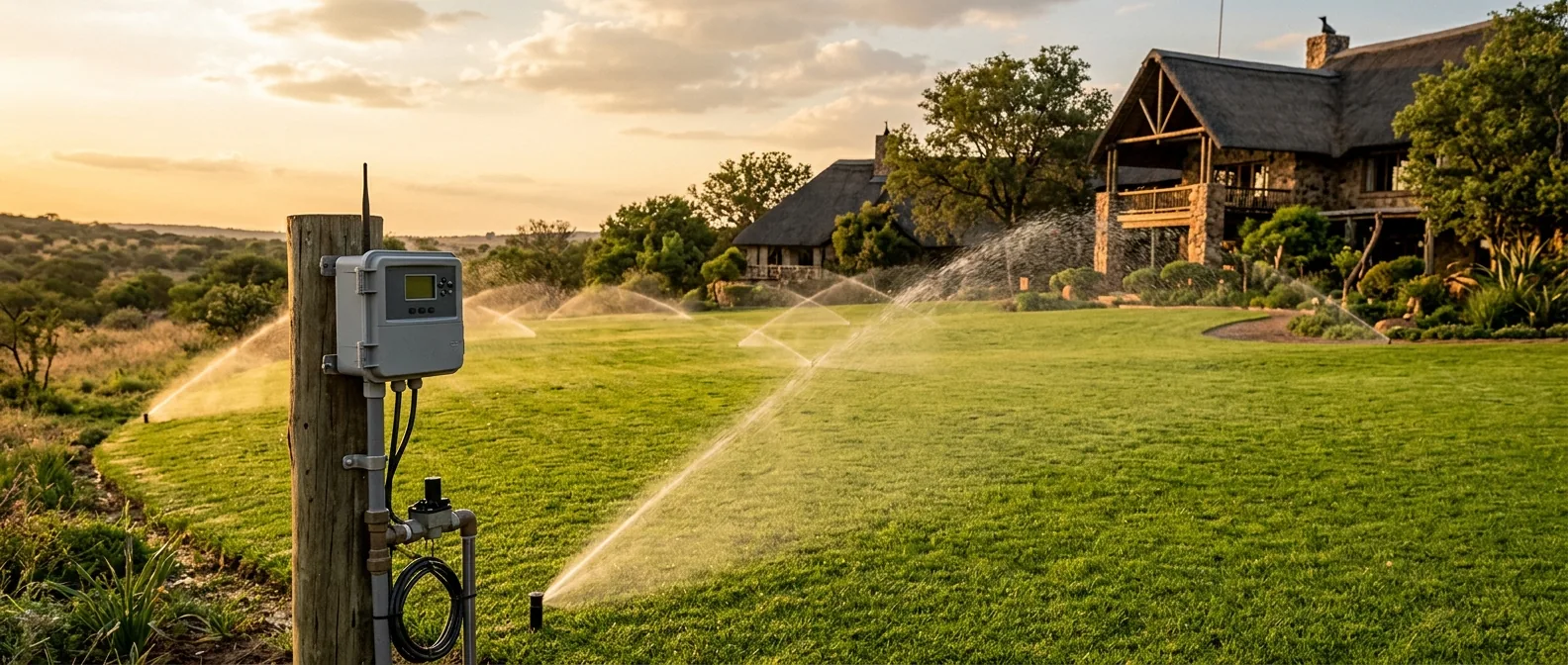
Micro-jets and mini-sprinklers are low-flow emitters that throw a controlled spray pattern over a defined wetting radius (1–3 m). They sit between drip emitters and full sprinklers in flow rate and coverage; widely used in orchard floors, tree-surround irrigation and screened sites.
- Wets the root zone of trees and orchard floors more uniformly than drip.
- Operates at low pressure (1–2 bar) with low energy cost.
- Offers a frost-protection wetting pattern on susceptible crops on cold nights.
- Provides easy visual inspection — blockages and faults are immediately visible.
- Citrus and sub-tropical orchards (avocado, macadamia, mango).
- Tree-surround irrigation on lodge and estate landscape.
- Screened, fenced or protected areas where rodent damage on drip is excessive.
- Sites with hard water where dripper blockage history is significant.
- ×Less efficient than drip — 80–88% on most installs.
- ×Wind sensitivity is real on exposed orchard sites.
- ×Wetted area between trees may grow weeds that need separate management.
- ×Not the right answer for premium ornamental gardens — drip is finer and quieter.
Where Micro-Jet & Micro-Spray is used.
- Shrub and ornamental beds
- Horticulture
- Greenhouse production
How HidroVerse deploys Micro-Jet & Micro-Spray.
We specify micro-jets on orchards and tree surrounds where the wetting pattern needs to be wider than drip but the precision of full sprinklers is unnecessary. Emitter selection, pressure regulation and filtration are designed against the field analysis.
A typical Micro-Jet & Micro-Spray treatment chain.
Micro-jets are a managed network — filtration, pressure regulation and flushing are non-optional.
Pre-treatment
Screen and disc filtration on the lateral header; pressure regulation by zone; flush valves at lateral ends.
Core stage
Micro-jet emitters on stakes or risers, throwing a 1–3 m wetting radius; selection matched to species and spacing.
Post-treatment
Zone controller logic; flushing schedule; fertigation injection where the crop demands it.
Waste handling
Flush-cycle water routed to between-row absorption; expired emitter heads collected and recycled.
Buyer's guide.
The questions every commercial buyer should put on the table before signing for a water system. Can't see yours? Send us a brief — a HidroVerse specialist replies within one business day.
Yes — we keep a current reference list organised by application and scale. After a short qualifying call we release names, contacts and (with the host's permission) site-visit options. The conversation between two operations managers is the most honest reference we can offer; we do not gate-keep it.
We start with a SANAS-accredited feed-water panel, profile your demand against verified occupancy or production data (not brochure numbers), and specify against the worst-credible feed and peak demand — with disclosed margins. If a simpler technology will hit the brief, we'll specify the simpler technology and tell you why. We do not earn more by over-spending you; we earn more by you renewing service contracts year after year.
PFD, P&IDs, sizing calculations against verified influent data, equipment schedules with serial numbers, control philosophy, pre-treatment justification, waste-handling and regulatory compliance trail. Audit-ready by an external ECSA-registered engineer is the standard we design to — not a brochure pack with marketing fluff.
Pre-treatment is technology-specific (sediment, hardness, chlorine, biological load) and non-optional. Skipping it is the single largest cause of premature failure on every membrane, media bed and disinfection stage. Watch for suppliers quoting only the core stage — they are selling you a 12-month problem.
Every consumable and major component has a quantified replacement trigger (differential pressure, flow drop, UV intensity drop, salt-passage drift). Replacement schedules and trigger limits are written into the HidroVerse Care contract — visible, auditable and triggered on monitoring data, not guesswork.
Critical components are specified with duty/standby and automatic fail-over so a single failure does not stop supply. Our SLA on critical lines is 4 hours on site; the median lived response over the last 14 months is 2 hours 40 minutes. Telemetry triggers tickets before the operator notices — most failures are flagged, not phoned in.
Continuous telemetry on flow, pressure, conductivity, turbidity and on-skid water quality. Monthly SANAS-accredited compliance sampling is included on HidroVerse Care — not invoiced piecemeal. The audit pack builds itself monthly so when DWS or your insurer arrives, the file is ready in 30 minutes.
Potable applications: SANS 241:2015 (mandatory under the Water Services Act 108 of 1997), the National Water Act 36 of 1998 for abstraction and discharge, NSF/ANSI component certification, WHO Guidelines for design margin. Wastewater: the relevant DWS discharge authorisation under General Authorisation 665 or a site-specific Water Use Licence. We sign off against the legal floor and design to a margin above it.
Survey 1–2 weeks, design 2–4 weeks, install 4–10 weeks, commissioning and proof of compliance 1–2 weeks — typically 8–14 weeks for a lodge or estate, longer for mining and municipal. Delays come from civil works, third-party council approvals and architectural changes; the engineered scope rarely slips.
Survey, lab analysis, design pack, equipment, install, commissioning, operator training, the first year of monthly compliance sampling and the agreed scope of HidroVerse Care. Civils, electrical reticulation, third-party council fees and any architectural integration work are quoted separately and scheduled into the contract. If your quote has 'allowances' and 'provisional sums' across the page, you are buying a future invoice.