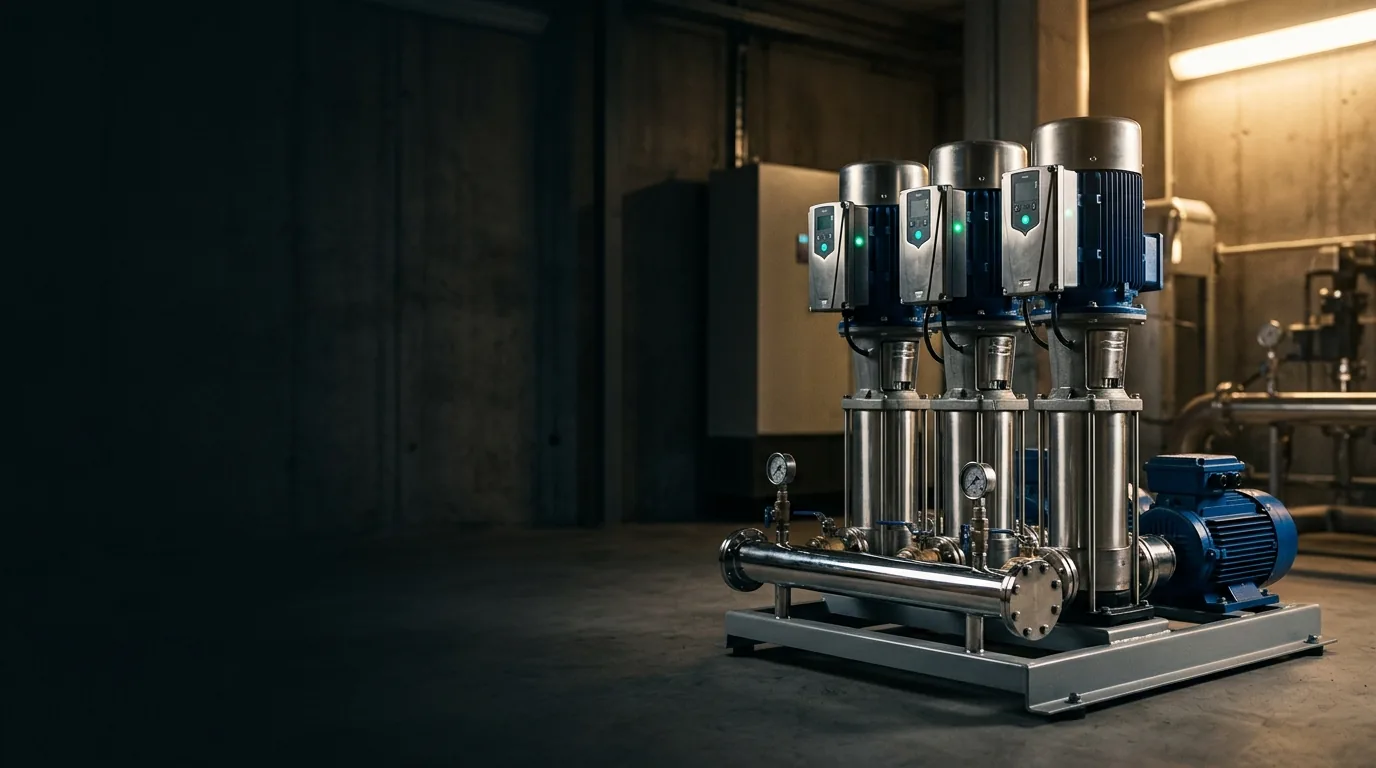
Booster Sets — Duty/Standby/Redundant
Stable pressure to the last guest tap — even on a full house.
The technology explained.
A booster set is a multi-pump, common-manifold installation that maintains a pressure or flow setpoint to a building or site. Pumps share duty automatically; standby pumps take over on duty-pump failure; staging logic brings additional pumps online as demand rises. Modern sets are VSD-driven with PLC or smart-controller logic.
- Delivers stable network pressure (typically ±0.2 bar) across full demand range.
- Provides automatic duty-standby fail-over with no operator intervention.
- Stages pumps efficiently across the demand curve, minimising energy per m³.
- Integrates with site telemetry for remote monitoring and alarm push.
- Hotels, lodges and apartment blocks with multiple floors and simultaneous demand.
- Estates with long reticulation runs and zoned pressure targets.
- Commercial sites where mains pressure is insufficient or unreliable.
- Sites that cannot tolerate pressure failure during peak occupancy.
- ×Wrong tool for single-tap or low-demand applications — a single VSD pump is more economical.
- ×Manifold pressure-loss budget must be designed in — under-sized headers throttle the whole set.
- ×Standby pumps need scheduled exercise to verify duty rotation works when called upon.
- ×Acoustic load can be significant — plant room location and isolation are design considerations.
Where Booster Sets — Duty/Standby/Redundant is used.
- Hotel, lodge and estate boosting
- Industrial process water supply
- Irrigation main-line pressurisation
- Fire pump duty-standby sets
How HidroVerse deploys Booster Sets — Duty/Standby/Redundant.
We specify booster sets wherever a single pump cannot honour the demand profile or the resilience requirement. Pump count, staging logic, manifold sizing, alarm interface and remote-control protocol are part of the engineered design.
A typical Booster Sets — Duty/Standby/Redundant treatment chain.
A booster set is a multi-pump system with logic — never just two pumps on a header.
Pre-treatment
Common-suction strainer, isolation valves on each pump, manifold sized for the worst-case duty pressure-loss.
Core stage
Multiple VSD pumps on common manifold, staged by PLC or smart-controller logic; duty/standby/assist sequence; alarm-mapped to telemetry.
Post-treatment
Bladder accumulator for short-cycle suppression; site-wide distribution; pressure-zone monitoring downstream.
Waste handling
Drain points on each pump and the manifold; sump pump where the plant room is below grade; flushing procedures on commissioning and post-CIP.
Buyer's guide.
The questions every commercial buyer should put on the table before signing for a water system. Can't see yours? Send us a brief — a HidroVerse specialist replies within one business day.
A booster set is an engineered package: multiple pumps (typically 2–4) on a common stainless suction and discharge manifold, with a controller that staggers duty, rotates lead pump on a programmed schedule, brings standby pumps online as demand rises, and isolates a failing pump without losing supply. The packaged controller is what makes it a system rather than a coincidence of plumbing.
Duty/standby = one pump runs, a second is held in reserve and rotates lead automatically. Duty/standby/standby = two duty pumps share load with a third on standby (used where peak is genuinely high). For critical lines — fire reserve, hospital water, primary lodge supply — we specify enough redundancy that the failure of any single pump still meets full peak demand. The architecture is on the design pack.
We build a demand profile from your occupancy curves, irrigation overlap, fire-reserve calculation and worst-credible-coincidence (every shower, every kitchen, every irrigation zone running at peak hour). The set is then specified against that profile plus a published headroom margin — not against the brochure flow rate of a single pump.
Cascade staging based on setpoint and demand, programmed lead rotation to even wear across pumps, dry-run protection, no-flow detection, over-pressure cut-out, fault logging with timestamp, Modbus or BACnet output to the building or estate management system, and remote alarm push to mobile. Not a pressure switch in a box.
Yes — a small bladder-type accumulator is fitted on the discharge manifold to smooth pressure transients and reduce micro-cycling on low-flow events (a single tap left running). Sized against the system volume and the controller's dead-band, not as a brochure default.
We design pressure sets to ≤55 dBA at 1 m on a hard-floor open plant-room test; with acoustic hoods the measured number is typically 45–48 dBA. Test condition (microphone position, plant-room reflectance) is logged on the commissioning sheet — so a future GM can argue against a noisy install if performance drifts.
Three layers, sequenced on the design: pressurised storage tank or roof reservoir for the first 30 minutes of supply at last outlet; UPS-backed controller so the set re-energises within 200 ms of the generator coming online; diesel generator changeover (typically 8–15 second crank) for sustained supply. The reservoir buys the time the generator needs to come up; the UPS keeps the brains awake.
Routine: motor and bearing inspection per OEM schedule (typically annual on commercial duty), seal inspection on the same cycle, valve and gauge calibration, controller parameter audit, log-file download. Pre-emptive: lead-pump rotation logs reviewed quarterly to balance wear. All scheduled and timestamped in HidroVerse Care; no call-outs to ask 'is it due?'
Pumps: 12–18 years on clean water at design duty. Motors: 18–25 years on quality bearings and good thermal management. Controller: 10–15 years before parts availability drives a sensible replacement. Set as a whole is typically refurbished in place once around year 15, rather than wholesale replaced.
Pressure sets supplying potable distribution: NSF/ANSI 61 on wetted parts; IEC 60034 efficiency; IEC 61800-3 EMC on the VSD; SANS 10252 hydraulic design for the distribution network. Fire-suppression sets: SANS 10287 + SANS 10400 Part T. Compliance trail delivered with the install.