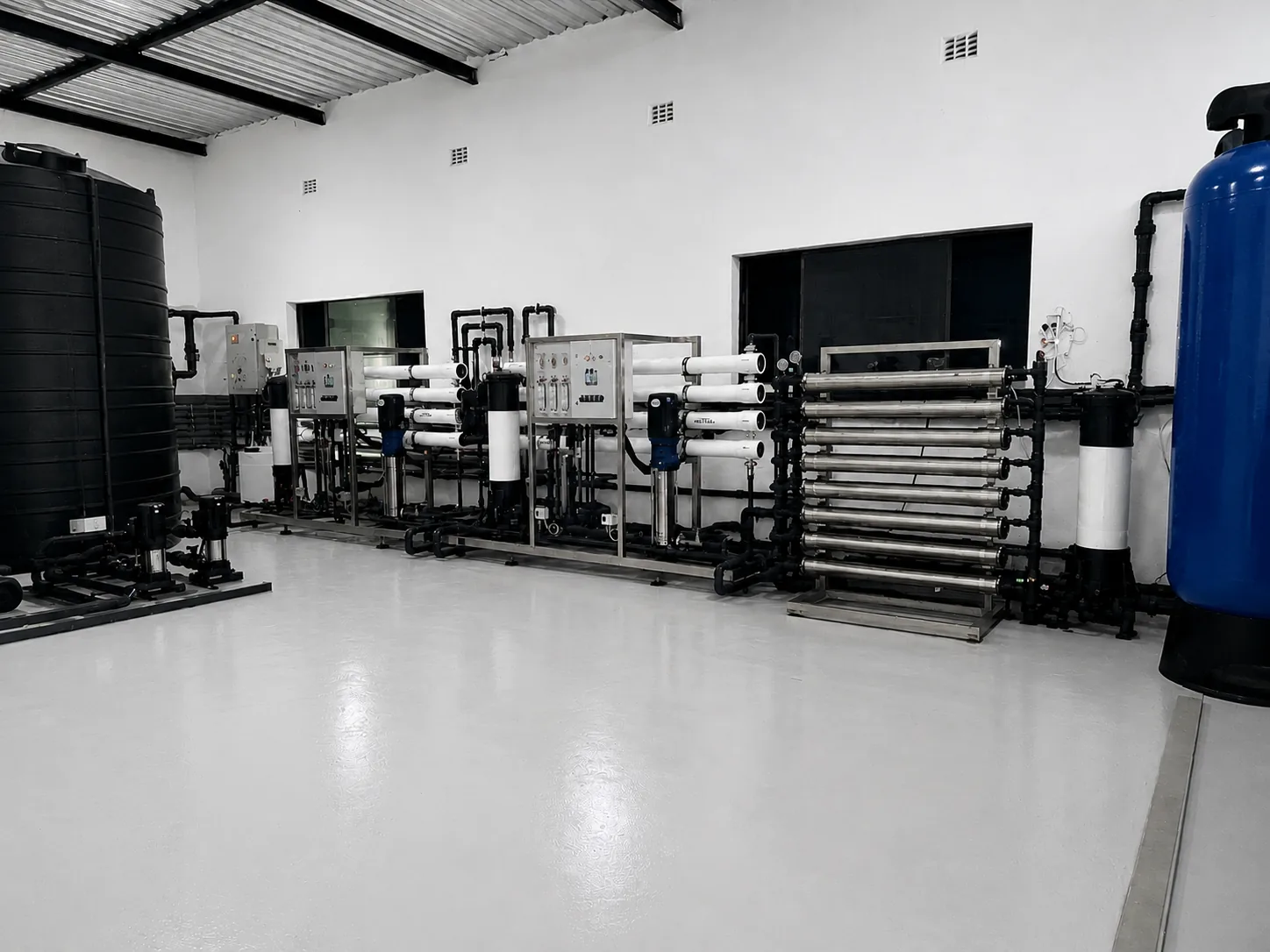
Reverse Osmosis (RO)
When the dissolved load is the problem — RO is the answer.
The technology explained.
Reverse osmosis is a pressure-driven membrane process. Feedwater is pushed at 8–18 bar (brackish) or 55–80 bar (seawater) against a thin-film composite spiral-wound membrane; clean permeate passes through, and the dissolved load is concentrated into a reject (brine) stream.
- Rejects 95–99.7% of dissolved salts (Na⁺, Cl⁻, SO₄²⁻).
- Removes hardness (Ca²⁺, Mg²⁺), nitrate, fluoride, sulphate.
- Removes heavy metals — lead, arsenic, cadmium, uranium — to ppb levels.
- Removes most small organics and pesticides above ~150 Da.
- Produces low-TDS permeate suitable for potable, beverage and high-purity industrial duty.
- Brackish boreholes with feed TDS in the multi-thousand mg/L range.
- Coastal sites where municipal pressure fails and groundwater is saline.
- Sites with non-negotiable potable-water targets — lodges, hospitals, food and beverage, pharma.
- Feeds where ion exchange or media filtration alone cannot reach SANS 241.
- ×Not a primary barrier against suspended solids — that is what pre-treatment is for.
- ×Not a true disinfection step on its own — bacterial barrier yes, validated disinfection no. UV after RO is the conservative answer.
- ×Less effective on volatile organics (THMs, light VOCs) — activated carbon is the right tool there.
- ×Dissolved gases (CO₂, H₂S, O₂) pass through and need degassing or pH correction afterward.
- ×Not the right answer for low-TDS surface water — UF and media-led trains cost less and last longer.
Where Reverse Osmosis is used.
- Brackish-borehole drinking water polishing
- Coastal and seawater desalination
- Industrial process water and boiler feed
- Bottling, beverage and food-grade water
- Pharmaceutical and laboratory ultra-pure water
- Cooling-tower make-up water
How HidroVerse deploys Reverse Osmosis.
RO is not a one-size-fits-all. We deploy it only where the dissolved load — TDS, hardness, iron, manganese, nitrate, fluoride, chloride, sulphate — cannot be addressed by physical or biological filtration alone, and only after a SANAS-accredited feed-water panel proves the case. On softer surface feeds we will recommend UF and media-led trains instead, because the lifecycle cost and reliability are better. When RO is the right answer, it is always paired with engineered pre-treatment and post-treatment as a single integrated plant — never as a standalone skid bolted onto a borehole pump.
A typical Reverse Osmosis treatment chain.
RO is never a standalone product. It is one stage inside a treatment train, and an RO plant that ships without engineered pre-treatment and post-treatment will fail — often within the first 12 months. Every HidroVerse RO install is designed end-to-end against the actual feed and the actual duty.
Pre-treatment
Cartridge or media filtration to bring SDI₁₅ below 5; antiscalant dosing matched to the feed-water Langelier or Stiff & Davis index; chlorine removal (activated carbon or sodium metabisulphite) to protect the polyamide membrane; UF as a guaranteed physical barrier on dirtier feeds. Inadequate pre-treatment is the single largest cause of premature membrane failure.
RO core
Spiral-wound TFC membranes from tier-one OEMs (DuPont FilmTec, Toray, LG Chem, Hydranautics, Lanxess), array configuration sized against feed TDS, target recovery, fouling risk and the energy economics of the site. Energy-recovery devices on seawater and high-salinity brackish duties.
Post-treatment
RO permeate is very low TDS and typically slightly acidic — left untreated, it is corrosive to copper, steel and cementitious materials. We re-mineralise via calcite/dolomite contactor or precision dosing of calcium hydroxide and CO₂, lifting hardness to 60–80 mg/L as CaCO₃ and stabilising pH around 7.5–8.0 (positive LSI / RSI). Blending with a controlled fraction of pre-treated feed is sometimes the cheaper route. Final UV disinfection is standard on potable duty.
Brine management
Reject at 50–75% recovery is roughly 2–4× the feed TDS. Disposal is site-specific — consented sewer discharge, evaporation pond, blended discharge with treated effluent, or concentrate recovery (zero-liquid-discharge) on high-value or environmentally sensitive sites. The route is part of the design pack and signed off against the water-use authorisation.
Other technologies worth knowing.
Buyer's guide.
The questions every commercial buyer should put on the table before signing for a water system. Can't see yours? Send us a brief — a HidroVerse specialist replies within one business day.
Reverse osmosis is a pressure-driven membrane process: feedwater is pushed at 8–18 bar (brackish) or 55–80 bar (seawater) against a thin-film composite spiral-wound membrane. The water permeates through; dissolved salts, metals, hardness and most small organics are rejected and concentrated into a brine stream. RO produces low-TDS permeate but is a removal technology — not a true disinfection step on its own.
RO rejects 95–99.7% of dissolved salts, heavy metals (lead, arsenic, cadmium), nitrate, fluoride, hardness (Ca²⁺, Mg²⁺), sulphate and most small organics. It is not a primary barrier against suspended solids — that is what pre-treatment is for — and it removes some volatile organics less effectively than activated carbon. Gases such as CO₂ pass through and are managed with degassing or pH correction where required.
Recovery typically runs 50–75% on brackish feedwater and 35–45% on seawater (using energy-recovery devices). Energy intensity is feed-dependent: modern brackish-water RO with efficient pumping runs 0.5–1.2 kWh per m³ permeate; high-salinity brackish 1.2–2.5 kWh/m³; seawater RO with ERDs 2.5–4.0 kWh/m³. The actual figure is calculated against feed TDS, recovery, temperature and array configuration during design.
DuPont FilmTec, Toray, LG Chem, Hydranautics and Lanxess — the established tier-one suppliers with published performance data, multi-year warranties and an active local presence. The specific element is chosen against the feed-water TDS, the target recovery, the fouling risk and the cleaning regime. We do not use unbranded or grey-market membranes.
At minimum: cartridge or media filtration to bring SDI₁₅ below 5; antiscalant dosing matched to the feed-water Langelier or Stiff & Davis index; chlorine removal (activated carbon or sodium metabisulphite) to protect the polyamide membrane; sometimes UF as a guaranteed physical barrier upstream. Inadequate pre-treatment is the single largest cause of premature membrane failure.
On a properly pre-treated brackish-water feed, RO elements typically deliver 3–5 years of service before the salt-rejection or normalised permeate flow drift outside warranted limits. Performance is tracked through normalised permeate flow, salt passage and differential pressure — three metrics our monitoring records continuously, so a failing membrane is flagged in time, not after the water quality drops.
Brine concentration depends on recovery: at 75% recovery the brine is roughly 4× the feed TDS. Disposal route is site-specific — sewer discharge with consent, evaporation pond, deep-well injection, blended discharge with treated effluent, or concentrate recovery (zero-liquid-discharge) for high-value sites. The route is part of the design pack and signed off against the relevant water-use authorisation.
RO permeate has very low TDS and is often slightly acidic. For potable distribution we typically re-mineralise (calcite/dolomite contactor or precision dosing of calcium hydroxide and CO₂) to lift hardness to 60–80 mg/L as CaCO₃ and stabilise pH around 7.5–8.0. This protects downstream piping from corrosion and meets the SANS 241 and WHO requirements for hardness, alkalinity and Langelier Saturation Index.
For potable applications in South Africa: SANS 241:2015 on the product water, the Water Services Act 108 of 1997 and the National Water Act 36 of 1998 for abstraction and discharge. Components are typically NSF/ANSI 58 or 61 certified (or equivalent). WHO Guidelines for Drinking-water Quality inform design margins. Specialised applications (food, pharma, healthcare) reference the relevant sector standard.
Continuous monitoring of pressure, flow, conductivity and recovery; routine cartridge changes (typically 4–8 weeks); periodic CIP (cleaning-in-place) cycles when normalised pressure drop or salt passage drift past trigger limits; antiscalant and pH dosing chemistry refill on schedule; SANAS-accredited monthly water sampling for compliance. All of this is included on the HidroVerse Care contract — not invoiced piecemeal.