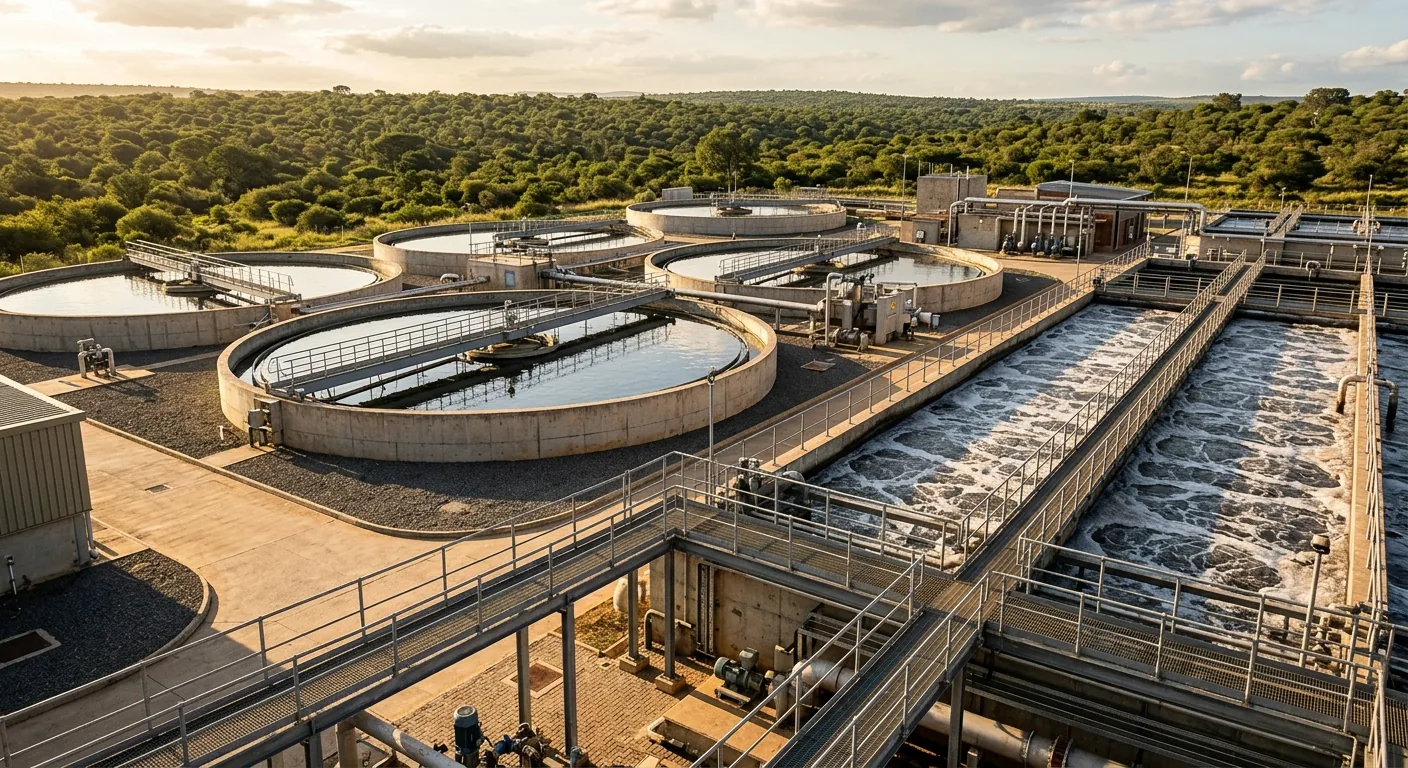
Aerobic & Biological Reactors
Where wastewater becomes water you can put back into the world.
The technology explained.
Aerobic biological reactors use a managed population of aerobic micro-organisms to consume dissolved organic carbon (BOD/COD) and convert ammoniacal nitrogen to nitrate. The two most common families — MBBR (moving-bed biofilm reactor) and SBR (sequencing batch reactor) — share the same biological mechanism but differ in vessel layout and process control.
- Removes 90–98% of BOD/COD on well-designed plants.
- Nitrifies ammonia to nitrate via Nitrosomonas and Nitrobacter populations.
- Settles biological floc to produce clarified effluent suitable for tertiary polishing.
- Can be configured for nitrogen removal with anoxic zones and recirculation.
- Lodges, hotels, estates and small towns where decentralised secondary treatment is needed.
- Sites with variable hydraulic load (SBR is forgiving of intermittent flow).
- Sites requiring nitrification ahead of reuse or sensitive discharge.
- Retrofits where biological capacity must be added inside an existing tank footprint (MBBR).
- ×Not effective against most pharmaceutical, personal-care or industrial recalcitrant compounds.
- ×Performance is temperature-dependent — winter design margins are mandatory.
- ×Requires reliable power for aeration — outages stress the biology and recovery takes days.
- ×Cannot reach reuse-grade quality alone; tertiary stages (UF, UV, disinfection) are required for reuse.
Where Aerobic & Biological Reactors is used.
- Municipal secondary treatment
- Lodge and resort biological treatment
- Industrial-effluent biological polishing
How HidroVerse deploys Aerobic & Biological Reactors.
Aerobic biological treatment is the workhorse secondary stage of almost every HidroVerse wastewater plant. MBBR for sites that need compact, retrofittable capacity; SBR for sites with strong batch flow profiles and stringent effluent targets. Tertiary polishing is layered on against the discharge or reuse target — not assumed away.
A typical Aerobic & Biological Reactors treatment chain.
Biological treatment is the secondary core of every wastewater plant — but only one stage in a sequence that starts with screening and ends with disinfection.
Pre-treatment
Screening, grit removal, FOG arrestor and equalisation tank to deliver biologically-feedable wastewater at controlled flow.
Core stage
Aerobic reactor (MBBR or SBR) with engineered aeration, dissolved-oxygen control and biomass management; anoxic zone where nitrogen removal is required.
Post-treatment
Clarifier or membrane separation; disinfection (UV or chlorine); polishing filtration for reuse-grade quality.
Waste handling
Waste activated sludge (WAS) dewatering and disposal; biosolids managed under DWS authorisation; non-conformant effluent diverted to recirculation, never released.
Other technologies worth knowing.
Buyer's guide.
The questions every commercial buyer should put on the table before signing for a water system. Can't see yours? Send us a brief — a HidroVerse specialist replies within one business day.
Yes — we keep a current reference list organised by application and scale. After a short qualifying call we release names, contacts and (with the host's permission) site-visit options. The conversation between two operations managers is the most honest reference we can offer; we do not gate-keep it.
We start with a SANAS-accredited feed-water panel, profile your demand against verified occupancy or production data (not brochure numbers), and specify against the worst-credible feed and peak demand — with disclosed margins. If a simpler technology will hit the brief, we'll specify the simpler technology and tell you why. We do not earn more by over-spending you; we earn more by you renewing service contracts year after year.
PFD, P&IDs, sizing calculations against verified influent data, equipment schedules with serial numbers, control philosophy, pre-treatment justification, waste-handling and regulatory compliance trail. Audit-ready by an external ECSA-registered engineer is the standard we design to — not a brochure pack with marketing fluff.
Pre-treatment is technology-specific (sediment, hardness, chlorine, biological load) and non-optional. Skipping it is the single largest cause of premature failure on every membrane, media bed and disinfection stage. Watch for suppliers quoting only the core stage — they are selling you a 12-month problem.
Every consumable and major component has a quantified replacement trigger (differential pressure, flow drop, UV intensity drop, salt-passage drift). Replacement schedules and trigger limits are written into the HidroVerse Care contract — visible, auditable and triggered on monitoring data, not guesswork.
Critical components are specified with duty/standby and automatic fail-over so a single failure does not stop supply. Our SLA on critical lines is 4 hours on site; the median lived response over the last 14 months is 2 hours 40 minutes. Telemetry triggers tickets before the operator notices — most failures are flagged, not phoned in.
Continuous telemetry on flow, pressure, conductivity, turbidity and on-skid water quality. Monthly SANAS-accredited compliance sampling is included on HidroVerse Care — not invoiced piecemeal. The audit pack builds itself monthly so when DWS or your insurer arrives, the file is ready in 30 minutes.
Potable applications: SANS 241:2015 (mandatory under the Water Services Act 108 of 1997), the National Water Act 36 of 1998 for abstraction and discharge, NSF/ANSI component certification, WHO Guidelines for design margin. Wastewater: the relevant DWS discharge authorisation under General Authorisation 665 or a site-specific Water Use Licence. We sign off against the legal floor and design to a margin above it.
Survey 1–2 weeks, design 2–4 weeks, install 4–10 weeks, commissioning and proof of compliance 1–2 weeks — typically 8–14 weeks for a lodge or estate, longer for mining and municipal. Delays come from civil works, third-party council approvals and architectural changes; the engineered scope rarely slips.
Survey, lab analysis, design pack, equipment, install, commissioning, operator training, the first year of monthly compliance sampling and the agreed scope of HidroVerse Care. Civils, electrical reticulation, third-party council fees and any architectural integration work are quoted separately and scheduled into the contract. If your quote has 'allowances' and 'provisional sums' across the page, you are buying a future invoice.