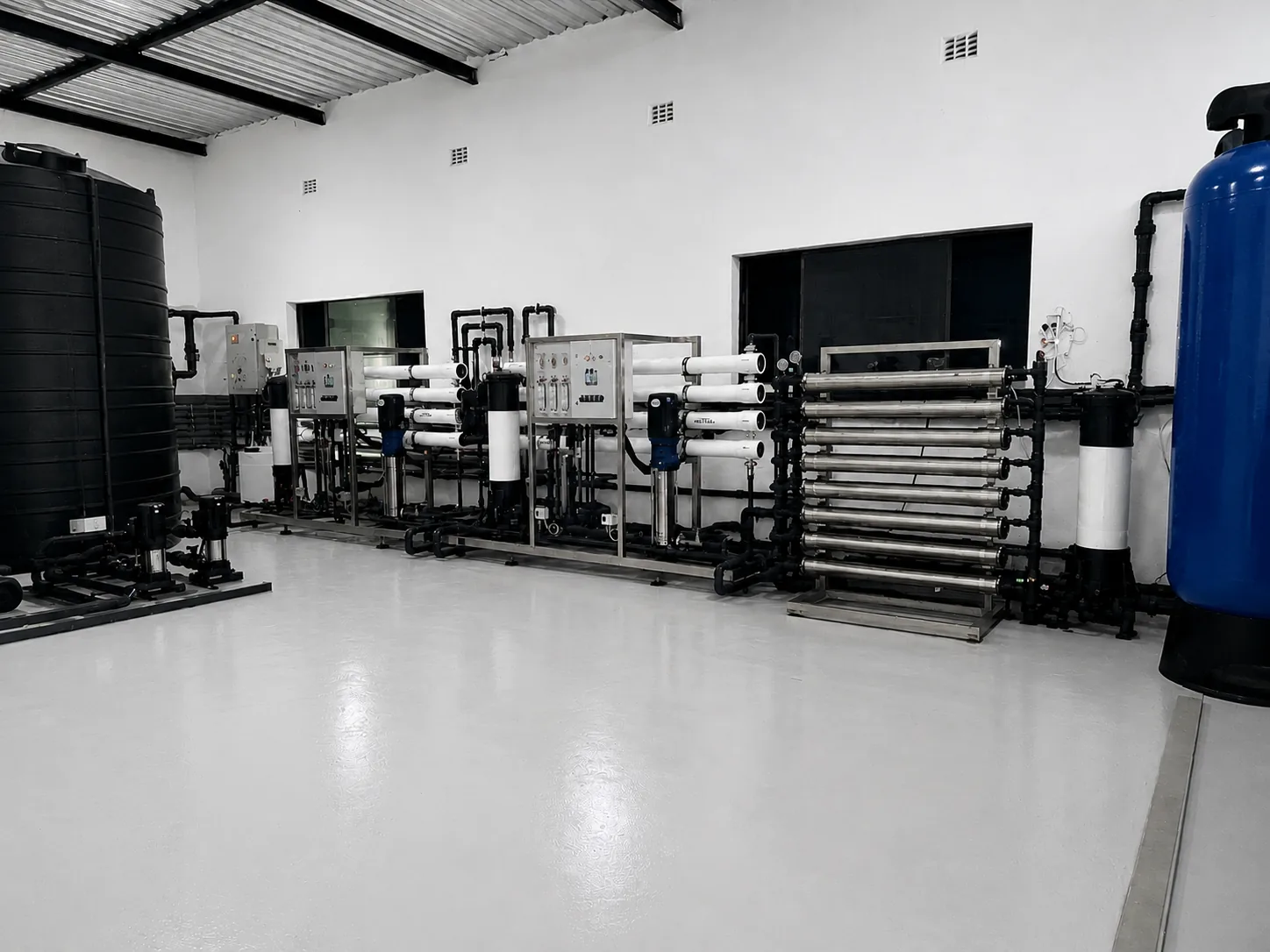
Lamella & Clarifier Systems
Without it, your membranes fail in months instead of years.
The technology explained.
A lamella clarifier is a coagulation–flocculation–settling stage that uses a stack of inclined parallel plates. The plate stack multiplies the effective settling area inside a compact footprint (typically 5–10× a conventional open settling tank), so a small skid handles flows that would otherwise need an open pond.
- Removes suspended solids, silt, clay and colloidal matter to single-digit NTU on a well-dosed feed.
- Removes natural colour, tannins and a large fraction of dissolved organic carbon when paired with the right coagulant.
- Precipitates iron and manganese after aeration or oxidant dosing.
- Removes phosphorus by metal-salt precipitation in tertiary wastewater polishing.
- Reduces the load on every downstream membrane, media bed and disinfection stage.
- River, dam and storm-water intakes with seasonal turbidity spikes.
- Municipal raw-water plants and small-town potable schemes.
- Sites where membrane plants are failing prematurely because pre-treatment was undersized.
- Wastewater tertiary polishing for phosphorus and residual solids.
- ×Not a disinfection step — pathogens pass straight through unless paired with downstream UV, ozone or chlorination.
- ×Not the right tool for dissolved salts, heavy metals (in dissolved form) or hardness — those need ion exchange or RO.
- ×Performance collapses without correct coagulant chemistry and dosing; it is an engineered process, not a tank.
- ×Footprint and head loss demands the plant be designed in at master-planning stage, not retrofitted under a deck.
Where Lamella & Clarifier Systems is used.
- Pre-treatment for membrane plants on river/dam/storm-water feeds
- Removal of silt, clay, colour, turbidity and biological load
- Phosphorus precipitation in wastewater tertiary polishing
- Iron and manganese removal after aeration
- Municipal raw-water treatment
How HidroVerse deploys Lamella & Clarifier Systems.
We deploy lamella clarification anywhere the feed water carries enough suspended or colloidal load to compromise downstream stages. The decision is led by the analytical data — turbidity, total suspended solids, true colour, dissolved organic carbon — and by jar-testing in our lab against the actual coagulant chemistry the site will use. We never bolt a clarifier onto a train as an afterthought; it is sized at design stage, integrated into the hydraulic profile, and matched with the right coagulant, flocculant and dosing strategy for the source.
A typical Lamella & Clarifier Systems treatment chain.
Clarification is never the whole train. It is a primary stage that conditions the water for everything downstream.
Pre-treatment
Coarse screening and grit removal (hydrocyclone or self-cleaning screen) to protect the chemical-dosing skid and the plate stack from rags, leaves and large particulates.
Core stage
Coagulation (PAC, alum or ferric chloride dosed against jar-test results) and flocculation, followed by gravity settling between inclined plates. Clarified water collects above; sludge slides into the hopper.
Post-treatment
Multi-media filtration, GAC polish and disinfection (UV or chlorination) downstream against the final-water target — clarification alone is not a finished product.
Waste handling
Sludge is wasted on a controlled schedule, dewatered (drying beds or geotextile bags) and disposed of as classified waste under manifest.
Buyer's guide.
The questions every commercial buyer should put on the table before signing for a water system. Can't see yours? Send us a brief — a HidroVerse specialist replies within one business day.
A lamella clarifier is a coagulation–flocculation–settling stage that uses inclined parallel plates to multiply the effective settling area inside a compact footprint. It removes suspended solids, colloids, colour and a portion of the dissolved organic load before the water reaches downstream membranes or media beds. Used as pre-treatment, it routinely extends membrane life from months to years.
On a well-dosed feed, a properly sized lamella stage delivers single-digit NTU turbidity from raw water that arrived in the double or triple digits. Suspended-solids removal is typically 85–95%. Colour and natural organic matter reductions depend on the coagulant chemistry but commonly fall by half or more.
Most lamella stages run on a metal-salt coagulant (PAC, alum or ferric chloride) followed by a polymer flocculant. Selection is led by jar-testing against the actual raw water — feed pH, hardness, alkalinity, dissolved organic carbon and target effluent quality all dictate which chemistry and dose work best.
A modern inclined-plate clarifier handles 5–10× the flow of an equivalent open settling tank in the same floor area. For a typical lodge or estate plant, the unit fits inside a small bunded plant room rather than needing an outdoor pond.
Settled solids slide down the plates into a sludge hopper and are wasted on a controlled schedule — typically once or twice per day for small plants. The sludge can be dewatered (drying beds or geotextile bags) and disposed of as classified waste, or routed back to a designed lagoon depending on the site.
We design every lamella stage with controlled start-up sequencing — coagulant on, flocculator on, plant ramp-up to design flow over several minutes — so the settling regime is established before the plant takes load. Cold-start is in the operating manual and the SCADA logic, not in the operator's memory.
Yes — that is what proper sizing is for. We design against the historically observed worst-case turbidity for the catchment, with headroom in the coagulant dosing range and surge capacity in the flocculator. Spike performance is part of the design pack.
Site-specific, but on typical river/dam feeds it runs in the low cents per cubic metre. The figure is built into the design pack so the operating economics are visible up front, not discovered after commissioning.
Coarse screening (self-cleaning screens or hydrocyclones) to remove leaves, debris and grit. We almost never feed a clarifier directly off a river intake without a screening stage.
A sand filter is depth filtration without chemistry — fine for moderate turbidity and clear feeds. A clarifier is a chemical stage that handles much heavier solids and colloid loads, including the seasonal turbidity spikes that overwhelm a sand filter. On river and dam feeds we typically run both, in series.