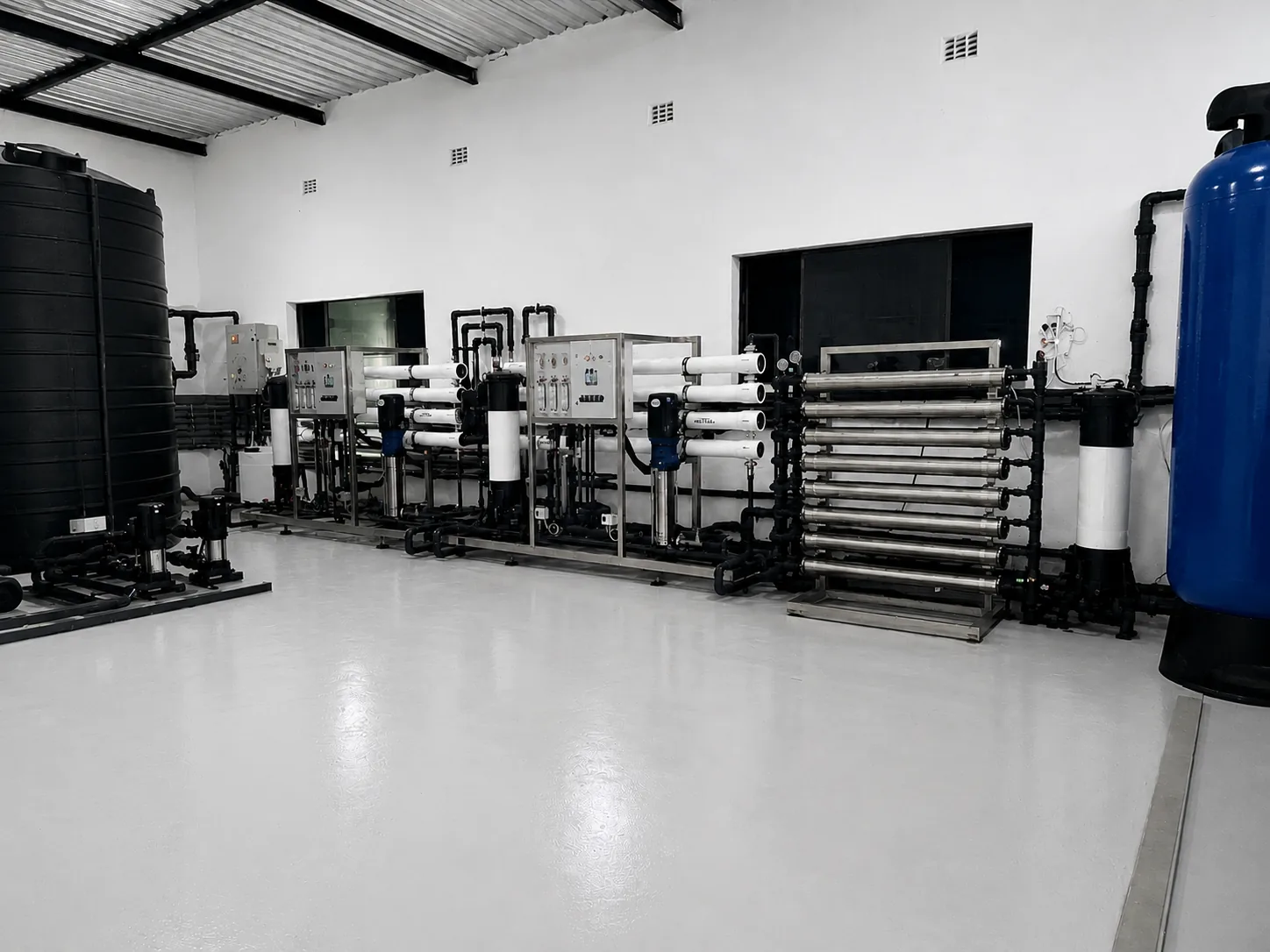
Multi-Media & Activated Carbon Filtration
The workhorse depth-filtration stage between pre-treatment and membrane.
The technology explained.
A multi-media bed is a pressure vessel layered with progressively finer media — typically anthracite, silica sand and garnet — at filtration rates of 8–12 m/h. Activated carbon (GAC) is run as a separate vessel or stage that adsorbs dissolved organics, residual chlorine, taste, odour and trihalomethanes. Both run on automatic backwash cycles.
- Removes turbidity and suspended solids down to roughly 10–20 µm in a single pass.
- Removes iron and manganese in oxidised form (with appropriate upstream aeration or oxidant).
- Removes free chlorine, chloramines, taste and odour at the GAC stage.
- Reduces dissolved organic carbon, trihalomethanes and many low-molecular-weight pollutants on GAC.
- Self-cleans on a scheduled backwash — no operator intervention between cycles.
- Pre-treatment ahead of RO, UF or UV on borehole, river and municipal feeds.
- Sites where membrane fouling is driving early replacements.
- Iron and manganese removal in groundwater treatment.
- Taste, odour and chlorine polishing on municipal-fed lodges, hotels and food-grade applications.
- ×Not a disinfection step — pathogens pass through unless paired with downstream UV, ozone or chlorination.
- ×Not effective on dissolved salts, hardness or most heavy metals — those need RO or ion exchange.
- ×GAC capacity is finite — exhausted carbon stops adsorbing and must be regenerated or replaced on schedule.
- ×Performance depends on correct media grading, bed depth and filtration velocity — under-sized beds short-circuit and over-foul.
Where Multi-Media & Activated Carbon Filtration is used.
- Turbidity reduction before membrane plants
- Chlorine, taste and odour removal (carbon stage)
- Iron and manganese removal (with greensand or oxidation pre-treatment)
- Final polish of treated water before storage
How HidroVerse deploys Multi-Media & Activated Carbon Filtration.
Almost every HidroVerse train carries a multi-media stage and a GAC polish. They are invisible to the user and indispensable to the engineer. The grading, vessel sizing and backwash strategy are designed against the actual feed-water analysis — we do not buy media beds from a catalogue and bolt them on.
A typical Multi-Media & Activated Carbon Filtration treatment chain.
Multi-media and activated carbon are intermediate stages — sized against what comes in and what must follow.
Pre-treatment
Coarse separation (screens or cyclones) and, on heavy turbidity, lamella clarification — so the bed does not blind in days instead of months.
Core stage
Multi-media depth filtration (anthracite/silica/garnet) for solids polish, followed by activated carbon (GAC) for chlorine, taste, odour and dissolved organics.
Post-treatment
Membrane stage (UF/RO) or disinfection (UV/chlorine) — multi-media is rarely the final stage for potable duty on its own.
Waste handling
Scheduled backwash water carries the trapped solids to a settling pond or back to the head of the works. GAC is regenerated or replaced when adsorption capacity is exhausted.
Buyer's guide.
The questions every commercial buyer should put on the table before signing for a water system. Can't see yours? Send us a brief — a HidroVerse specialist replies within one business day.
A pressure vessel layered with progressively finer media — typically anthracite on top, silica sand in the middle, garnet at the base. Water passes downward at 8–12 m/h; coarse material catches large particles at the top; finer media polish at the bottom. The bed self-cleans on a scheduled backwash cycle. It is the workhorse depth-filtration stage between pre-treatment and membrane on almost every train we install.
Granular activated carbon (GAC) is an adsorption stage, not a particle filter. It binds dissolved organics, residual chlorine, chloramines, taste and odour compounds, trihalomethanes and many low-molecular-weight pollutants. The iodine number of the carbon is selected against the contaminant load — a higher iodine number means more adsorption capacity.
Multi-media filtration takes turbidity down to 1–2 NTU on a well-fed bed, with suspended-solids removal at 90% or better. Below 1 NTU is achievable but typically requires a coagulant-aided stage upstream.
Yes — when the iron and manganese are oxidised first (with aeration, chlorine, ozone or potassium permanganate) and the bed includes the right media. Greensand and pyrolusite-based media catalyse the oxidation and capture the resulting precipitates.
Typically every 12–72 hours depending on feed load. Backwash is automatic, triggered by differential pressure, scheduled time or treated-volume — whichever comes first. The cycle uses 1–3% of the treated water flow.
Multi-media bed: typically 5–10 years with normal operation. GAC: 1–3 years before regeneration or replacement, depending on the organic load and the iodine number selected.
Coarse screening or a hydrocyclone is a near-universal upstream stage. If the feed carries heavy turbidity or colloids, a lamella or sedimentation stage upstream extends bed life significantly.
Yes — that is the classic GAC application. A correctly sized carbon vessel removes free chlorine and chloramine residuals to below the taste threshold.
Media beds used in potable applications are typically specified against NSF/ANSI 61 (drinking-water materials) and operated to deliver product water that meets SANS 241:2015. Pressure vessels are designed against the relevant PED or ASME code.
Backwash water carries the trapped solids and goes to a settling pond, a sludge holding tank or — on small plants — back to the head of the works for re-treatment. The route is decided at design stage against the site's discharge consent.